Thursday, November 19, 2009

Day Six--Amarana Part Two

Akhetaten, the city of Akhenaten. I can see why Egyptologists call it Amarna or Tel Al Amarna instead of Akhetaten. I can never keep the name of the King and the name of the city straight and I’m betting neither can most people.

This is the reason for my trip. The reason I can on this tour and not another. To visit Middle Egypt. To see the land where Akhenaten and Nefertifi set up their new city. To be honest, there isn’t much to see. A crescent of desert bounded by the Nile and high rocky cliffs But the very air is infused with the romance of the period and I am excited beyond imagining.

We drive to what I can only describe as a landing area, where we park the bus and Fadel points up the side of the high cliffs where little dark blotches appear—the royal tombs. That is our first destination.


There are stairs, many many many stairs, leading up the side of the cliff, but fortunately there is also a trail alongside them. It’s much easier to trudge up a trail in blinding sun and broiling heat than it is to do a stairmaster in the same condition. I have a couple of bottles of water in my pack, but I’m really wishing I had gotten a camelback pack so I could just drink and pant. The climb may not be all that tough in reality, but it is hard for me. Not only because I’m out of condition, but because every step grates on my knees, but I am absolutely determined that I will finish the climb, no matter what. I trail behind the rest of the group, but in some ways that’s a relief because I know I’m not obstructing anyone. I’m panting. No, I’m gasping. Fadel’s assistant who has accompanied us on this part of the trip, a beautiful young woman who works as a professor of architecture most of the time tells me to breathe through my nose instead of my mouth. I would if I could, I think. Right now I’m just focused on breathing period.


Our armed guard, who rides on the bus, notices me and waits at one of the slightly more level spots, his eyes questioning. “I’m okay,” I say. Well, that’s probably a lie. I’m probably near heat stroke, but if I have to die, Amarna is as good a place as any. I stop, red-faced and puffing, about 15 steps from the top and the guard takes me by the arm and pulls me the rest of the way.


I am standing on the rim of train far above the valley floor. My God, I’ve made it. I’ve made it to the Royal Tombs of the Heretic King.


Now I’m not sure if my heart is pounding because of the climb or because of excitement or some of both. There are 25 tombs in this area, but we are visiting only three of them. (Thank God. Walking a narrow ledge on the side of cliff in the desert isn’t on my list of things I want to do very often.) The tombs themselves aren’t awesome in the same way that the Temple of Karnack is said to be awesome, but what makes them so incredible to me is that I know members of the royal court stood here, on the same ground I’m standing on. It’s a bit like standing in the agora at Athens and realizing that St. Paul debated the philosophers in that very place. A tangible connection with history in way that erases the centuries. My mind is swirling and I’m almost dizzy. Not from heat stroke, but from the realization that I am actually here.

As Fadel guides out of the tomb of Ahmose, “Fan-bearer on the King’s right hand,” I linger a bit, standing in front of an image of the King and Queen on their way to the Aten Temple. The curtain of time parts for just a moment and I feel as if I am actually witnessing the moment in reality, the first recorded worship of a single god by a monarch. I wonder where the belief in monotheism came from? Did Akhenaton get the idea from the Hebrews? Some people suggest that Moses might have been raised with him or been his tutor and he developed his idea of a singular powerful god from that influence. I’m not sure the time frame of the Exodus has ever been clearly established so without access to some current data, I can’t say if that’s plausible or not. The similarity of Ahkenaten’s hymn to the Aten with the Psalm is striking however. It simply can’t be coincidence that two prayers, from the same part of the world, would be almost word for word identical. I remain in front of the painting as long as I can, in an act of homage and reverence. It is a holy moment for me, a moment suffused with grace and gratitude, a moment to be tucked away in my soul forever.

We walk slowly, walking quickly in this heat and ledge edge would be very unwise, to two more tombs, including the tomb of either Pentu, the royal physician, or Panehsy, a priest. I honestly can’t remember which is which. Now if their names didn’t both begin with “P,” I might have had more luck.

The bus is very very far below us and with an unpleasant jolt, I realize we do have to walk back down there.

Fortunately, we do not retrace our steps, but the trail down is steep enough to cause an ache in the thighs. I stumble once and the guard catches my arm. I’m not panting nearly as much on the way down as the way up so I don’t think he fears for my life. He hands me a spring of mint that he found god knows where. Surprisingly, the crisp fresh aroma is invigorating and I crush the leaves to release their scent.

Once we are back at the bus, we proceed along flat nothingness to what was the Northern Palace. I hadn’t realized just how large Amarna was. It’s about nine miles from side to side and three to four from the Nile to the rock cliffs, a massive undertaking for a city that would exist only 30 or so years and become a highpoint in artistic design. The Northern Palace was Nefertiti’s home near the end of the period. Her mother in law came for a visit and shortly afterwards, Nefertiti and the children moved out of Ahkenaten’s palace to this place on the northern edge of the city. I wonder what the mother in law said or did that created such a rift in what had been a happy family? One of the little human dramas lost literally in the sands of time.

The traces of the palace can be seen in low walls and flooring. It doesn’t look like much now, but once upon a time it was the epitome of modernity with bedrooms, bathrooms, public rooms, reception rooms, gardens, pools, and servants’ quarters, complete with structural details that caught the northern breeze and created a sort of natural air conditioning. Even though the area is guarded by barbed wire and I couldn’t actually walk on the palace floor, just knowing that I was within feet of where Nefertiti and Tut, Meretaten and Ankhesenpaaten, Horemheb and Ay lived, loved and plotted takes my breath away. (And I have recovered my breath since the cliff trek!)

From the Northern Palace, we drive a surprisingly long way to the ruins of the Temple of the Aten which consists on one rather phallic looking column and the broken remains of the main altar. It’s difficult to mentally reconstruct what this must have looked like, even with the evidence of paintings and murals which are now in places like the Cairo museum. I try to imagine how the area would have been laid out, but one pillar just isn’t enough to give a clear idea. I’ll have to find a recreation somewhere. As I stand next to the column, it reminds me of the single pillar that remains of the Temple of Diana at Ephesus, a lonely reminder of what was once one of the seven wonders of the ancient world. In its own way, this temple too, was one of the marvels of the ancient world and now it has been reduced to a solitary sentinel.

We retrace our route out of the desert back to the fertile land bordering the Nile to the ferry that will return us to the other side. This time, we share our space with a donkey cart and a truck.
Our fashionista is not called on to drive the ferry this time; maybe it’s a different captain or perhaps it’s nearing the end of the day and there is no time for frivolity. Just get over the river and back to home. We reboard our big bus (we had taken a smaller, almost van-like bus to the actual site), I look out over the land, seeing what King Akhenaton saw for the land cannot be all that much different than it was when he first decided to build here. The sweeping scope of the flat plain, the soaring cliffs, the broad Nile with its rich fertile banks. No modern structures, no cell phone towers or electrical wires mar the vista. It possesses a certain timelessness that I can only hope will last another thousand years.

Our hotel for the night is, well, interesting. It is apparently a private hotel for employees of a cement company, sort of like a corporate residence. The rooms are enormous. You almost need a breadcrumb trail to get from the bed to the bath, but the sheets are threadbare and slightly stained, the shower sprays everywhere but down and in place of a washcloth, we have a sponge mat. I wash the dirt of the day off my face and hands and go down to the dining room for dinner, where we are served kushari, a traditional Egyptian meal, consisting of rice, lentils, chickpeas, macaroni, and caramelized onions. It sounds like it might be a heavy pasta sort of meal, but it’s actually very light and flavorful. I guzzle water, wondering where I put my Advil, listening to my fellow travelers chat about the day. My mind is no longer here. It is somewhere back on a rock cliff, overlooking a gleaming city rising out of the yellow sand, returning to vibrant life after millennia of sleep.

I have fulfilled my dream. I have seen Amarna. Everything from now on will be lagniappe.

Friday, November 13, 2009

Day 6 on the way to Amarna

I wake up with an incredible surge of excitement. Today we are going to Amarna. This is the reason I am on the tour. I would have paid the entire price just to go to the site of Akenaton’s city. I have dreamed of this place and visited it a thousand times in my imagination. To see Amarna with my own eyes. Can it even be possible?
But to prolong the anticipation or maybe because of the way the roads run, we first are going to Tuna el Gabal, the necropolis for the ancient city of Hermopolis.
I’m beginning to grow accustomed to the sight of mud brick houses with dirt floors, and ducks, donkeys, goats, and buffalo on the front porch, but I am still startled to see a woman sweeping the ground with a reed broom just a little bigger than a whisk broom under the gaze of a satellite dish. Fadel calls Egypt the land of contradictions and indeed it is—arid and fertile, modern and ancient, donkeys and cell phones. It is as if the front foot of the land has stepped into the 21st century while the back foot remains in the 1st.
If I can divert a bit from the travelogue, I think it is the mixture of the new and the old that most Westerns can’t understand unless they experience it first hand. The people retain a sensibility of the centuries, of farming, of living along the river, of the vast desert. Their minds and mindset are still shaped by the same forces that shaped the lives of their ancestors. And yet they now talk on cell phones, carry submachine guns and drive motorcycles, all the while transporting sugarcane to market on donkeys and washing clothes in the river. It’s no wonder they see the world in ways those of us who have never pounded our underware on rocks can’t understand. Ancient minds in a modern world make for a tinder keg where responses to situations can have disasterous consequences. Until we who live in the West realize that just because someone wears a tie and carries a iPhone, he doesn’t think the way we do, I believe there will be continual misunderstanding and confusion. And yet, especially here in Egypt, the people are gentle, kind and hospitable. It is possible for the world to live in peace. We just have to work a little harder at it.
Okay, small political commentary over. I’ll try to stick to ancient sites for the rest of the entry. As we pass a Coptic Church with a large mosaic image of Our Lady on the front, Fadel says that Egyptian tradition holds that Joseph and Mary brought Jesus to Heliopolis, the City of the Light, when they fled Israel to avoid the Massacre of the Innocents. It’s interesting to realize that I have been to Jordan where Jesus walked as an adult and now to Egypt where he walked, or rather toddled, as a child.
It is very early in the morning…at least for me since we got on the bus by 7:30 am. In the villages or even larger towns instead of workers heading off to offices, the water buffalo are being brought to the fields. Every now and then I see a man with a briefcase waiting to cross the road alongside a buffalo. That’s certainly not something you’d see anywhere in America. Because it gets so hot here, work starts in the cool of the morning. I see a man wielding a hoe in the field looking exactly as if he has stepped out of a wall carving. His hoe unchanged in four millennia. He raises it over his head and pulls up a chuck of dark, black soil. Over and over, he carves the earth, readying it for planting. In the next field over, another man sows, flinging seeds from a leather pouch over his shoulder just as his ancestors have done from the beginning of agricultural cultivation. The seeds spray in an arc and almost in the same motion, he reaches into the pouch and repeats the gesture over and over.
A small truck passes us, overladen with cabbage,cauliflower, tomatoes and at least three people standing on the bumper, hanging onto the top with one hand. Fadel says that a recent law has made talking on the cell phone while driving illegal because it is too dangerous. Apparently falling off the back of rapidly moving vechiles isn’t a danger, but I’d take cell phone chatting over holding on for dear life any time.
I’m surprised by the number of Christian symbols I see in this part of Egypt, even though the Copts were among the first believers in Christ. I just assumed that Chrisitianity had been completely supplanted by Islam and so seeing crosses and images of the Virgin stop me. I am particularly surprised to see a mosque right next to a Coptic church. The minuret next to the Cross. I wonder what the Crusaders would think if they could see the at least nominally hospitable relationship?
Tuna el Gabal is another one of those remote, rarely visited by tourist sites. I sometimes get the feeling we are waking the guards up from their naps when we drive up to the gates. Fortunately for me and my aching legs, we aren’t going to be doing any climbing until this afternoon. The catacombs of the god Thoth are an easy walk from the guard stations.
I really didn’t know what to expect. I knew that Thoth was represented by either an ibis or a baboon and that these catacombs had been used to store mummies offered to him, so when we descended, not all that far under the ground to see a city of the dead was breathtaking. As far as you can look are corridors filled with little niches for ibises and bigger niches for baboons. In some areas, piles of pottery are tossed aside, either because it is worthless or because it awaits further investigation. Either because we are with Fadel or because so few tourists visit the area…or both…the guard brings out an actual ibis mummy for us to touch. The resin coating makes it very hard and very heavy, almost like a brick. Despite the layers of wrapping and coatings, you can still see the shape of the bird, with his head tucked back under his wing as if he had merely been asleep for centuries and might, at the behest of the god, suddenly awake from his slumber and send forth his call of adoration. The guard also brings out a sarcophobus filled with ancient linen wrappings. We are allowed to touch. I can barely believe it. We are touching a mummy and its wrappings. The linen is very heavy, finely woven, but weighty. It still remains its white color although additional fabric on the bottom is a deep saffron.
I could have stayed in the catacombs for much longer, just staring into the niches and exploring the area devoted to baboons where a sculpture of a baboon scowls across an offering table and a baboon mummy, its unwrapped skull grinning in grim amusement. Even in life, baboons are unattractive animals with their large canines and pointed snouts and mummification does little to improve their appearance. With reluctance we waddle after Fadel back out in the heat of the desert. If this is what it is like in November, god help us what it must be like in July or August. I either would never go outdoors or die instantly of heat stroke. I’m quite sure those would be my only two options.
Before we leave this site for Amarna (Oh Amarna, I’m coming; I’m coming. It won’t be long now.) we visit the tomb of Petosiris, a man who lived at the time of Alexander the Greek and who had his tomb done in the new-fangled Greek style. Well, sort of done. All the scenes are typical of Egptian tombs with the characteristic front/profile posture of all Egyptian art, but the clothing is Greek.
I’m getting anxious to see Amarna. I’m sure Petosiris and his tomb are very interesting to scholars, but I have deliberately avoided anything to do with the Greco-Roman period of Egyptian history on this trip, Perhaps another time, to see Alexandria and explore that later facet of history. But not now. Now I want to see what I came to see. The city of the Horizon of the Aten, the home of Akenaton and Nefertiti and Tutankamen—Amarna.
But not yet. I’m beginning to feel like a kid on Christmas eve, thinking that Christmas morning will never come. We bundle back into the bus and watch the movie of life stream past the window. More villages, more children, more laundry, more donkeys, more dirt roads. We stop to see all that remains of a Temple to Thoth, two huge baboon statues. People leave the bus to take pictures, but I am too excited to waste energy on Thoth, so I snap an image through the bus window and take a deep breath. Soon. It has to be soon.
Fadel tells us that we will be leaving our bus to take a ferry across the Nile and board a smaller bus that will take us to the actual site of Amarna. The ferry is definitely not for tourists. We share it with schoolgirls in their navy clothes and white veils, obviously some sort of uniform; mothers, babies, a vegetable truck and a donkey cart. We are as much a source of intrigue and amusement to the other passengers as we are to them. I catch the eye of one young mother who has been staring at me and smile. She smiles back, clearly embarrassed that she has been seen, but the universal language of the smile erases the unease. A grandmother sends a frightened young boy and a bold young girl over to shake my hand and welcome me to Egypt.
As we pull away from the dock, our fashionista, who has never met a stranger and who is one of the most outgoing, exhuberent women I have ever seen, gets invited by the captain to steer the ferry. I suspect it is on underwater steel cables, so she won’t be able to drive us around on a sandbar, but her blond presence in the wheelhouse causes amusement among Americans and Egyptians alike.
Finally, we get on the bus that will take us to Amarna. As we pass by a newly cultivated field, a cloud of white butterflies performs a ballet in the blinding sunlight. My heart dances with them.
I am almost there.
What is it like to visit the place of your dreams? Sometimes, when you see something you have imagined forever, it isn’t what you expect and you are, as much as you hate to admit it, just a touch disappointed. I felt that way when I saw the Mona Lisa. So small. So unimpressive. So not what the Mona Lisa was supposed to be like. Part of me was fearful that I would experience that same sense of disappointed when I finally laid eyes on the Temple to the Aten, the Northern Palace, the Royal Road. But the part of me that could have been an archaeologist knows that there probably won’t be much to see, except rubble and sand, and besides, it isn’t the ruins, but the land, the horizon, the place that I have come to experience. If nothing remains to be seen, so much the better for then I shall see what Akenaton saw when he sailed the Nile and declared, “Here I shall build my city and here I shall live for the rest of my life.”
At last we are there. How can you even begin to describe what is being processed internally while still trying to describe what is being seen externally? How do you step back enough to report while being flung mentally back and forth over the centuries? How do you put a dream into words?
Amarna is desert. Pure and simple, both in the metaphorical and actual sense. There is nothing here but rocks, dirt, sand and heat. Akenaton was looking for a virgin location to establish his new city and this certainly would have been that. Even now it’s about as desolate as you can get and still be near the banks of the Nile which we know the city was from ancient illustrations and documents. But it is filled with light, filled with the glory of the one God, the Aten. The words of his Hymn to the Sun, which are almost identical to Psalm 102 of the Hebrew Scriptures, fill my mind:
Because Thou has risen, all the beasts and cattle repose in their pastures; and the trees and the green herbs put forth their leaves and flowers. The birds fly out of their nests; and their wings praise Thy Ka as they fly forth. The sheep and goats of every kind skip about on their legs, and feathered fowl and birds also live, because Thou has risen for them.
Why does Akenaten’s hymn sound so much like a prayer to Yaheway of the Hebrews? Could it be that Moses, raised as one of the children of the Kap, the household of the Pharaoh, might have been Akenaten’s friend? Could he have passed on the idea of the one god to the man who would be King? The similarities are too close to be mere chance. Somehow there is an overlap of influence here. What might have happened to the world if Akenaton’s beliefs had prevailed? How would the course of history have changed? Things to ponder in the night.

Wednesday, November 11, 2009

Day 5--Entering Middle Egypt

Day 5 Middle Egypt
Today we begin our journey into Middle Egypt, an area of the country where tourists rarely go because it simply hasn’t been safe in the past. I’m not exactly sure it’s safe now, but this is the reason I’m on this trip. The things I want to see the very most are located in Middle Egypt—Amarna in particular.

But first we head to Al-Fayyum and the Pyramid of Maydum. The images flicking by my window are endlessly fascinating. I’ve discovered that I prefer to sit on the starboard side of the bus. Not exactly sure why, but I instinctively favor that side and when I’ve been forced, like today, to take a port seat, I kept scouring the bus for an empty seat on the right (literally) side. As we leave Cairo, the fields unfold like black and green leaves of a living book. When the field is freshly cultivated and the rich black soil mounds, herons fill the rows like strings of white fairy lights. Every now and then the head heron must give a signal because they all fly to a tree and perch there like Christmas tree ornaments until it is time to redecorate the fields.

As the bus stops for a non-existent traffic light, a family dashes across the street—the father in one of the long grey robes whose name escapes me, but I’ll eventually look it up, the mother in a burka and the little boy in a full-on military uniform with shoulder epaulets and chest medals. I wonder who is the ruler in that household? The little family disappears in the village streets and then the village itself is left behind as we make a sharp turn onto another road.

We are on the Desert Road which runs parallel to the Nile in the, yes, desert. This part of Egypt is filled with a good deal of rubble. Half-build, or half-destroyed—it’s hard to tell the difference houses and multi-story buildings are everything. As are piles of dirt that look like miniature pyramids, made of rocks, dirt, yellow sand, red sand, chunks of old concrete, limestone bricks, red bricks and even just plain garbage. This is truly a land of pyramids, some intentional, some accidental. What puzzles me is where the garbage comes from in the middle of the desert, for with that shocking abruptness that is so characteristic of Egypt, we have crossed from the Black Land to the Red Land in a literal heartbeat. Perhaps it blows in across the miles of undisturbed sand. Where the sand is not criss-crossed with wheel marks (and at least 90% of it is), the land does look like waves on a red, dry ocean. Every now and then, we see a camel or a donkey, the ships that sail this desolate landscape. Next to the road, lies a dead water buffalo. He looks as if he had simply dropped of exhaustion and dehydration, his legs giving way to breathe his last on the scorching desert. I have expected to see vultures circling, but maybe it’s too hot even for scavengers.

Everywhere in the midst of this nothingness are short, as in one or two brick high walls or small triangles, like corners of imaginary houses. Fadel explains that these are the way people mark their land. Even if you should purchase the land officially, it would hard to prove it is yours without these boundary markers. Akhenaton did the same thing when he moved his capital from Thebes to Amarna—established his domain with boundary stellae in the desert.

All of a sudden, and I do mean, all of a sudden, we are surrounded by lush green, palm trees and flowers—the Al-Fayyum oasis. In Pharoanic times, it was a favorite hunting area of the Kings. While the area has been modified since Amenemhet I of the 12th Dynasty drained the swamp and formed a reservoir, the Aswan Dam has blocked the flow of fresh water and the once vibrant area used for water health cures has become small, polluted and salty. However, the area is still a literal oasis.
I never really understood what an oasis was like until now. Imagine nothing as far as you can see but sand. Imagine being as hot as you have ever been…and then upping that by about 10%. Your mouth is cotton, your head is aching and you are on the verge of heat stroke when you see green. A mirage? A hallucination just before you drop to become bleached bones? No, it’s real. Trees, grass and blessed, life-giving water. Your relief, your joy, your gratitude would be almost indescribable. You who were near death have been given life again. We who live in areas of mountain rives cannot fully appreciate the importance of potable water.

Soon we are at the Pyramid of Maydum, another not on the tourist trail site. Maydum is of interest because it is the transitional form between the Step Pyramid and the true pyramids of Giza. It’s sort of hard to describe, so I’ll put up a picture as soon as I can. What’s very cool is that we get to go inside—and not with hoards of other tourists clamoring about the site, vendors hawking the same identical wares for “one day alone” bargains. Just us and the Ministry of Tourism guards—and their guns. I don’t know guns, but they carry heavy-duty firepower. I definitely don’t want to be in a situation where they decide to open fire.

To get into the Pyramid of Maydum, you climb up the pile of rubble that extends maybe 1/3 of the way up the side and then mount a rather precarious wooden stairway with those unpleasant open steps that look way way down. Once you get to about the middle of the pyramid (have I mentioned we have been doing a great deal of climbing? If no, we have.) you descend a steep ramp/stair of a type favored by the inside of pyramid conservators all the way to bedrock. At that point, you (or we) are once again at the very bottom of the structure. Then begins the fun part—an Indiana Jones type ladder ascending to the burial chamber which is about 2/3 of the way back up the Pyramid. I don’t like ladders. I don’t like ladders that go straight up a Pyramid in the dark. But this is one of those things that you either commit to or don’t but there’s no changing your mind part way through. So up and up we go. The burial chamber which, like all the others, is empty, is also extremely hot and crowded with sweaty American tourists pretending to be Egyptologists. The main feature of this pyramid, besides being a transitional form between the Step and the “real” is the corbelled ceiling which will eventually reach its zenith in the Grand Gallery of the Great Pyramid. However, being hot, tired and facing the descent down the Temple of Doom ladder, architectural features are not exactly captivating my attention at the moment.

Back on the bus (obviously I survived getting out), we leave the desert to return to the banks of the Nile where small villages with dirt roads, smiling children and omnipresent, overloaded donkeys reemerge. Everywhere laundry hangs from upper story windows, the whites blinding in the unrelenting sun. How they get their whites so white is a mystery since the women pound their laundry on the roads along the side of dirty irrigation canals. I can’t see how they can get anything clean in such filthy water. I can’t even get my socks clean using Woolite in a hotel sink! The women use large flat metal basin to cart their laundry to and from the river. In one home, a woman with a heaping basin hangs her clothes to dry while three children play in the dirt courtyard. As we leave the village, a young boy on a donkey try to race the bus. As we pull ahead, he smiles and waves. I suspect the donkey merely pants.

Old fashioned hand pumps pop up every few “block” so it is clear that the houses do not have running water. With my American sensibilities, I find it a bit disconcerti8ng to see goats, donkeys, dogs and children all going in and out of the streetside entrance to the house.

One of the most striking features of this part of Egypt is that almost everything under current construction is built of white brick with mud mortar. The fresh limestone gleams in piles but once used in contraction, the wall takes on a grey hue as the black mud stains the stone.

Once again images race by: A man trotting on a donkey, talking on his cell phone. A woman kneeling on a dirt street, rinsing clothes in a huge basin. Children smiling and waving. Men smoking water pipe, their beautiful silver and ornate designs a jarring contract to the dirt floor homes. Little shops with bottles of coca cola. Bread makers, their grills smoking. Fruit stands with lush looking, not to be eaten by delicate travelers, fruits and vegetables. Bundles of reeds stacked by the side of homes. Those same reeds—and corn stalks—creating fences around courtyards and homes.

And in the distance, the high hills of Middle Egypt.

I won't have internet connection for several days, maybe inshallah, so I probably won't be posting. I appreciate the comments. It's a blessing to share this trip with you who are reading.

Monday, November 9, 2009

Day Four--Storehouse of the Pharaohs

Today’s schedule features the Cairo Museum, a visit to several mosques and shopping in the Khan el Kahalilli market. As we maneuver the incredibly crowded streets of Cairo in our huge bus, suddenly there it it—the striking pink Cairo Museum, the premier museum of the world for Egyptian antiquities—which only makes sense since it is in Egypt.

The crush of the crowd pouring into the garden area is dizzying. I catch snatches of German, Japanese, Italian, British English and American as we pass through the security screening and follow Fadel into the first room where we cluster around Namer’s Palette, the commemoration of Menes’ unification of Upper and Lower Egypt. One of our group keeps muttering, “It’s Namer’s Palette. It’s Namer’s Palette. Oh my god, it’s Namer’s Palette.” I have to admit it’s almost surreal to see something I’ve known from art history classes, Egyptology reading and the history of the ages. Pristine, unmarred by the centuries, it is an astonishingly beautiful piece of functional art.

But there is no way to linger as the crowds press behind us and we sweep into the Great Hall which looks a bit like a cross behind an exhibit hall and a storage area. Everywhere the eye feasts on a buffet of history and art until the mind can barely absorb more but it would take a lifetime or perhaps two to look at every object, so gapping and gawking, we attempt to keep up with Fadel’s voice on our radios as we make our way to the second floor where Tut’s artifacts are kept.

I have seen some of these when they toured the United States in the 70s but a finely orchestrated exhibit of select pieces isn’t the same as seeing the objects together. I’ve seen many pictures of Tut’s tomb…the first book I read as a girl was an account of Howard Carter’s discovery, but the size and the extent of the objects is almost impossible to grasp. No wonder the only thing he could say when he was asked if he could see anything was, “Yes, wonderful things.”

We move from case to case, looking at Tut’s famous mask, his sarcophagus, his jewelry, his clothing. In one of the displays holding the third of his nested chapels is a piece of linen that looks as if it were a modern polka dot scarf. The dots appear to be sequins sewn onto the material, but I can’t see the underside. It is so contemporary in appearance, I thought for a moment it was a protective drape, although why a drape would be polka dotted did cross my mind.

After racing through some highlights, like a sarcophagus that was cracked in construction, the famous statue of the dwarf, his wife and children, daily artifacts and a blur of other objects, we are given 45 minutes to return to areas we most want to look at. (Just an apologetic aside here. Somewhere along the line, my Guidebook to Egypt has gotten lost so my memory not being what it could be, I’ll have to fill in the names of things like the dwarf when I find another Guidebook, or get home, whichever comes first. )

I immediately head back to the Amarna Gallery and after circling through the cases holding Kiya’s canopic jar, a rough-cut head of Nefertiti and exquisite wall paintings of marsh lands, I slide down, back to the wall to commune with the statue of Akhenaton. Looking into the slightly almond shaped eyes, noticing the rather delicate hands, large hips and full lips, I feel like I am truly seeing the Heretic King. I can’t stop staring into his eyes. What made him decide to abandon the old ways and worship a single god? What made him move his capital from Thebes to the desert and build an entirely new city? What was it about his passion that made the beautiful Nefertiti become his companion in the new religion? I ask the questions much more educated scholars than I have asked for centuries, but Akhenaton merely smiles that slight smile as if he knows we still search his mind for answers.

I decide to return to Tut’s exhibits while I still have a few minutes and, as I turn a corner near a staircase somewhere in this labyrinth of a museum, I come across a smallish case holding the funeral bouquet that Tut’s wife placed on his coffin. I couldn’t be more awestruck if I came across a relic of the True Cross. This is it. This is THE artifact that began my fascination with the Boy King, the Heretic King and the 18th Dynasty of Egypt. I can remember reading about this bouquet when I was five years old and trying to imagine what it looked like. In my mind all these years, it’s been a wreath, but this is much more like a modern funeral spray, the stems bound at one end. The petals are all dried to the same brownish color, but for a moment I see them in their vivid freshness—yellow, orange, red, blue—the same colors of the flowers that we see today at the side of the road. I can see the young Queen placing them on her husband’s coffin, her eyes red-rimmed, but her composure intact, as befits a queen. Perhaps the closest we have seen in modern times were Princess Diana’s boys, racked with grief at the death of their mother, but composed and old beyond their years. Such a very human object in the midst of all the splendor. A bunch of flowers, carefully gathered and laid on the lid of Tut’s coffin, a final gesture of affection that we all can understand, King and commoner, no matter how much millennia separate us.

I check my cell phone time and I have about 15 minutes left. Museums with their miles of corridors and marble floors are tiring places at best and I’m truly on sensory overload. Not to mention I ache from my shoulders down. I must find a place to sit, away from the crush of tourists where I can regain a modicum of mental, physical and spiritual equilibrium, so I slide between two massive columns, perch on one of the marble steps and gaze down the main gallery of the museum, past the mosaic floor that came from Akenaton’s palace to the great statue of Amenhotis III and his wife Ti. The museum is not especially well lit and this gallery is particularly dim, which is somehow quite fitting. It lends a mysterious, almost eerie air to the exhibits, an atmosphere of the ancient which no modern museum, no matter how well built, can ever completely convey.

It’s time to meet up with the group for the next part of the day’s activities and I have an agenda. I don’t always mean to take the road less traveled, but this time I feel compelled. I am going to remain here at the museum while the rest of them see Islamic Cairo, have lunch and go shopping. I have come this far and two hours with these treasures is not long enough. Perhaps there will be another time for mosques and another day for shopping. If not, I am making the choice that is right for me.
Having informed the guard that I was going to return and praying he understood, I leave the sanctuary of artifacts and emerge into the almost blinding sunlight. We are to meet at the garden pond which is planted with blue lotus and papyrus, probably the only place we will actually see these plants that were so important in ancient times. The lotus looks just like the paintings or perhaps one should say that the artists of old exactly capture the image of the lotus. A bit like a water lily, its vivid blue flowers, which apparently have some kind of opiate like property, rise on the end of long floating stalks to dot the surface with splashes of color. The papyrus is a reed with a very feathery top that looks a little bit like the crown of a miniature palm tree. It quivers in the slight breeze, make the whole grove look like it is dancing.

I tell Fadel that I am not going with them and return to the museum. I have a twinge of regret that I’m missing out—I think we all want to do everything and hate to think someone has had a better time than we have had—but life consists of choices. We have to choose and not look back because each of us, even if we are together on the same trip, has a different journey. And mine is at the museum.
The first thing I want to see is the mummy room, which costs an extra $20. When I think I’m looking at the faces of the some of the greatest personages of history, $20 seems a bargain. When I think I’m paying $20 to look at dead bodies, it seems a little macabre. No benches are in this room and it’s not permitted to lean on the cases, even to hold your place in line, so I sit on the floor. I’ve sat on many a floor in many a museum over my lifetime so now I can add the Cairo museum to the collection. I’ve got my back against the wall, staring at the profile of Tutmosis III and butts of tourist. The tourist butts come and go, but Tutmosis is still. He is very small, as are most mummies, partially because the body is completely desiccated and partly because the ancient Egyptians were smaller than we are today. His skin is polished black leather and his face looks almost like it has been shrink-wrapped with his flesh. I consider how mummies were created to preserve the dead for eternity and sitting here on the floor of the Cairo museum, I say part of the ancient prayer of the Dead, asking that his Ka and the Ka of all those in this room live forever and reminding him that he is, even now, remembered by the living. If being remembered and prayed for is immortality, then those in this room have achieved it.

Moving along the rest of the cases, I’m suddenly dumbstruck. My god, I've just looked into the faces of Hatshepsut, Ramses the Great and Seti I. I’ve seen portraits of these Pharaohs, seen wall-carvings and drawings, but now I have seen them, their mortal remains, the visages of men and women who left their indelible mark on history. It is almost incomprehensible.

Hatshepsut was my age and fat. Good heavens, I have something in common with her! Apparently she also had bad teeth, but fortunately I don’t share that attribute. Seti I was a very handsome man, even in death, his strong smooth forehead and almost kindly or at least placid appearance is striking. He looks like a man you could enjoy a beer with. Ramses was old…and he looks it. His once-white hair, now stained a yellow-red by the mummification process—was wispy and thinning. He looks like he was a crabby old man. Since we get the face we deserve, he probably was. Of course, like Hatshepsut, he had very bad teeth and I can personally attest that when you are in a lot of pain, you look and act rather crabby, so I’ll give him the benefit of the doubt.

The crush of the tour tourists has dissipated and I return to Tut’s gallery where only a handful of people remain. I stand before his throne, his baby head that Carter wanted to take out of the country, his gloves, his underwear, his sandals, his pillows with no one else around. I can look for as long as my over-stimulated brain can take it is. I do wonder how he wore the underwear, however. In two pieces, it looks a bit like an oversized diaper with a sash. I think the museum should put up a picture of how it was worn. His shoes look exactly…and I mean exactly…like today’s flip flops. Same identical design. If you worn them on the streets today no one would give you a second glance.

I simply meander through the chambers, finally finding a bench behind his folding throne with its black and white paw design in, portable folding stools on my left and another smaller stool with lion paws on my right. As I write in my journal, a young girl with a bright pink head scarf smiles shyly at me. Suddenly a woman in her late 20’s wearing a gorgeous brunt orange veil, says “Excuse me.” I look up, thinking perhaps I’ve taken someone’s place, but the woman says that her niece wants to talk to me, but is too shy. So with her auntie translating, we have a long conversation. She tells me I have beautiful eyes and wants to know if I have a handsome son. Apparently young girls all over the world are the same!

I’m glad I didn’t opt for the walking/shopping tour. I’m tired and the fibro makes my legs ache horribly. I sort of wander from bench to bench which is fine because everywhere I perch I see something incredible, something I could stare at for hours. Part of me wishes I had taken this trip a few years earlier, when I wasn’t in quite so much pain from the fibro, but then I realize that everything happens in its own good time. I worry that I am holding up people on the tour and I probably am overcompensating by walking faster than I need to, but I don’t want to be that “fat old lady on the trip who always worn green and made everyone wait.” Now that that little rant/confession is out of my system…the next thing I stumbled on were the sarcophaguses of Tut’s fetuses, tiny little coffins that spoke of parents’ grief. I felt a wave of compassion for Tut’s wife, losing her babies and her husband at such a young age. Then at the next corner I encounter three wigs from the 22nd dynasty. They look like giant tightly curled Afros with long braided plaits down the back. They also looked very hot and very itchy.

As I keep wandering, more and more artifacts sweep in and out my vision. Tools, cosmetic cases, vases, lamps, bows, weapons, statues…it’s beginning to be a mental blurr. One of the things I’ve noticed is the windows in this place. They are extremely high on the walls and most of them are open. Clearly rain damage isn’t an issue, but I wonder if they are ever closed and how they would ever reach them to close them. I’ve been approached a few times by men wanting to give me a tour—“Best guide in museum” and I’ve had opportunity to practice my “La!” but I’ve learned that I am unapproachable when writing in my journal. Aha!

The next room brings me Tut’s royal chariots. They are gorgeous, the Lamborghinis of their day, I’m sure, inlaid with ebony and gold, but they also are rather frail looking and I think they must have been dangerous to drive at high speed with their spindly wheels and delicate bodies. Maybe, like other tomb goods, these were never meant to be used in this world, but merely in the next. However, the chariots, like all the other objects are astonishingly beautiful. Mundane objects, perhaps, but infused with an incredibly artistry and craftsmanship. What is our culture going to leave behind? Flip phones and plastic bottles?

One small dim room contains jewelry from various dynasties. The pieces are very modern in appearance, perhaps because there are only so many ways to make earrings and necklaces, string beads and assemble pendants. Many of the pieces appear too heavy to wear. The earrings in particular would require ear piercings at least the dimension of a pencil, perhaps larger and they look as if they would weigh the lobe almost to tearing. I would like a pair of earrings from Egypt, but not a replica of these.

I circle back to Tut’s nesting chapels, looking for the front and back signs Fadel pointed out. Apparently on the front of each is a lion’s head and on the rear the lion’s tail, a rather ingenious way of keeping front and back clear when they packed the chapels one in the next. I start to sit on a bench to write, when a woman security guard moves it and I back away, but she gestures that I should sit. So I do and she begins to talk to me, asking questions and telling me that her job is to keep people from talking pictures. I ask her about her headscarf and she takes the one peeking out of my bag and arranges it on my head so that I look like a proper Egyptian woman. Then she uses my cell phone to take my picture and I chuckle at the incongruity of a no picture guard taking my picture. I am almost unrecognizable hidden like a Muslim woman. (When I can get the picture off the phone, I’ll put it up here.) She summons another guard and insists that I take a picture with her. I’ve been paying and paying to take pictures of people here and now someone wants my picture. She is sad to learn I am not married and don’t have a financee, but says, “Someday!” with enthusiasm. She talks and talks to me, telling me how to get a taxi and not to pay one pound over 20 pounds to get from the museum to the Sofitel El Gaziah, our hotel. She then walks me to the way out, saying over and over she wished that I would stay longer in Cairo and she would show me her city. That would be nice, but alas, I’m on a tour that resembles the Bataan death march and I must not linger.

Getting the taxi was truly one of the most frightening adventures of my life. The guards at the gate summoned someone for me and after a bit of negotiating he agreed to take me for 20 pounds, always wheedling for at least 25. We approach a street with 8 lanes of traffic and he says, “Take my hand.” I do and we dive head-long in the squealing, swirling, honking maelstrom. A bus comes within inches of my knees and the taxi driver slaps it on the front to make it stop. We weave in and out of cars in a way that would give every American mother heart failure if their children did it and finally come to the medium. I wonder if he is going to ask for the additional 5 pounds. If he says 25 pounds or I leave you here, I’d gladly give him 50 because there is no way in hell that I could ever get across the next four lanes. I’d either be hit or have a heart attack or both. But he doesn’t hesitate and we plunge back into the fray, dodging and darting buses, carts, cabs, cars in a blinding dash. His cab is surrounded by other cabs and I wonder how he will get it out, but squeezing through holes with a good quarter inch on either side, we are swept into the stream of traffic. I’m not sure I’ve made it clear where I wanted to go, but after crossing several streets where I was utterly convinced we were going to die, we arrive at the back gate of the hotel. I pay him his 20 pounds and stumble out of the cab, mentally and physically whipped.

I go out on the balcony of my room, pretending that I don’t have any acrophobia or vertigo. The din of the city below is almost deafening…honking horns, police sirens, the rumble of motors and yet, somehow, serene at the same time. Above the surges of sound, comes the call to prayer, a high haunting cry that soars above the clamor, reminding me that no matter by what name we call the Divine, we are here, on this earth, as his (or her) children and all we experience, including our very lives, is a result of that Divine Creative force and love. The lights of the city begin to twinkle and I can see the faint wake of a small motorboat making its way up the Nile. Tomorrow we will be following him.

Just as an update: I don't know if there will be internet access the next few days, but as soon as I can I'll be logging on.

Friday, November 6, 2009

Day Three--Part Two

The days are very long and very full and very tiring, so by the time we get to the hotel, clean up, eat dinner and return to the room, I'm one tired girl. So here's part two of Day three, even though the tour is now on day five. I am keeping notes, however. Just not able to write everything that happens during the day before I fall asleep. As always, I don't know from hotel to hotel if I'll have internet access, but I'll post as often as we do. And whenever I can, I'll have pictures to fill in as well.

With that: Driving to Dashure, Part Two.


We are at a small, modern museum in honor of Imhotep, the great architect. Fadel tells us that Zawi (he uses the familiar so shall I) has been establishing museums at the sites, rather than bringing all the artifacts to the main museum in downtown Cairo. The centerpiece of the museum as two life-sized statues with portrait features who appear as if they could almost speak. The details are incredible, even if they are a bit idolized. Not that I doubt all ancient Egyptians sported six-packs to die for, mind you. The personalities of the owners are clear. One, with a thin black moustache, must have been a bit of a dandy. I can imagine him making sure his robes were just so in the morning before he left the house and I can see him thoughtfully stroking his moustache whenever he had to make an important decision.

In one of the galleries, I see my first alabaster cups. I didn’t realize just how translucent alabaster really is until I see these. They almost glow from the inside and to think they are made of stone! The stone carving processes is shown in a relief and I notice that one of the workers has two “buffers” that he uses to smooth the surface. It’s hard to imagine how much work it would take to carve even the most simple of stone vessels, much less produce them in sufficient quantity for regular use. If it were up to me, I might get one made in the course of a lifetime and if anyone tried to use it, well, that just wouldn’t happen. The most beautiful piece, in my mind, is a cosmetic palette in the shape of chubby fish. I wouldn’t mind having my mascara in one like it, but I’m not sure it would be the same made out of plastic anyway.

On the way out, we stop to watch a film (in English) about the Step Pyramid, how it was built and excavations in the area. I have to admit I was more excited about the theater style chairs and a/c than I was the film, although I’m sure it was a fine film. I don’t know what it is about museums that are so exhausting and so hard on the legs and feet. By the time I’ve spent an hour in a museum, I feel like I need a good massage or a stiff drink. Or both.

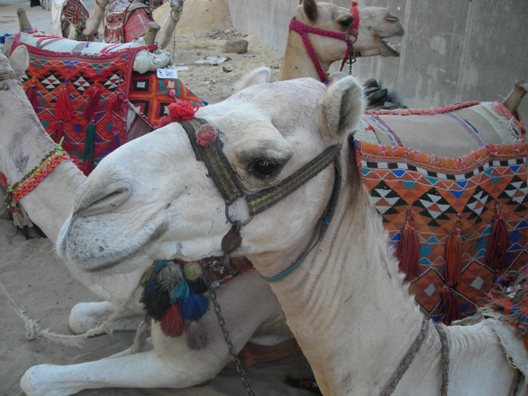
Our next stop is the mastaba tomb of Tiy, another out of the way, not your usual tourist place, although as soon as we arrive, camels almost magically appear with their owners ready to take us down from the parking area to the tomb for a nice fee.
I’m really torn. It’s a fair walk and I’m getting very stiff and very achy, not so much from the exercise, as the fibro (that’s my story and I’m sticking to it!) so a camel is very appealing. But I also want to know what it’s like to walk in the Sahara so I decide on the trek instead of the ride. Walking in the Sahara is just about what you’d expect it to be like. Hard slogging. The sand is relatively fine, even though it is hard packed in most places and so you have to work hard to move at any pace.

The tomb of Tiy is a gem in the middle of windblown sand, best known for its intriguing depictions of everyday Egyptian life. The reliefs in the courtyard have been worn down and only the slightest traces of color remain, mostly red with a little yellow. Inside, however, the colors are brighter. The scenes themselves are incredibly life-like and detailed. I was particularly taken with an image of three cattle being herded across a stream. The herdsman has a calf on his back and you can tell which is Mama Cow by the wild-eyed look and open mouth. In fact, you can almost hear the mooing!

As in most places, the attendant is all too excited to have you take a picture, followed by rubbing thumb and forefinger together, the sign for hand over the money. A one dollar American bill, which is about 5 Egyptian pounds, is universally welcomed. American money might not be valued much in the states, but the dollar bills remain a virtually universal currency. I do have a couple of Euros in my bag, just in case there was a massive crash of the dollar. (Not really. They were left over from the last trip abroad and just happened to be in my money belt.)

Outside the tomb, the ever resourceful camel drivers have come down and now offer ride back up the hill. This time, I take them up on the offer. Camels are broad and tall and my foot managed to get stuck on the back knob of the saddle. I felt…and looked…like a fool with one foot in a stirrup and the other stuck half-way across the camel’s back, but the driver simply lifted my shoe up and over and voila! I was abroad.

I just want to say that riding a camel, despite the rocking motion, the extreme height, the butt-bone numbing saddle is much better than walking in the desert. If you are given the option of walking or riding a camel, take the camel. I had heard Fadel say the going rate was about 20 Egyptian pounds or $5 so I offered the guy $3, expecting to go up to $5, but one of the other women in the group had paid $20 American and so I was expected to as well. I didn’t. Despite a pounding heart that I could hear in my ears, I only gave $5 American. I think the head of the drivers’ was not a bit happy, but I figured I was paying the going rate and they had already gotten much more than they expected from the other woman.

The Step Pyramid itself is located way off the main tourist track, or at least it feels that way to me. Perhaps when I get back, I’ll add some of the history to the account, but for now, just remembering what we saw is taxing enough! But stepping back to the Step. The entrance to the Pyramid Complex (pyramids all seem to be placed in complexes. Or perhaps they get a complex if they don’t have a complex?) is through a small, but very lovely corridor of columns, the first true columns in the world, Fadel tells us. The tops are representations of bundled reeds and the whole entrance is designed to create the sense of entering into the abyss of eternity, just as a sailor would send his craft into the marshes and, to prevent the return path from being obliterated, would tie the actual reeds together to mark the road, so, too, this path symbolically does the same thing.

The Step Pyramid is aptly named. It really does look like steps, and the creator is said to have told his Pharaoh that he was building a stairway to heaven. Fadel explains that while it now looks like the levels are rough, in the original, they would have been faced with smooth limestone and it probably would have resembled a giant white staircase. Off to one side is what looks like a tollbooth containing some of the most ancient graffiti in the world, carefully protected behind glass.
One of the more interesting parts of the site is the ruins of the markers for the Heb-sed festival, an event held every 30 years during a King’s reign. As part of the ceremony, he ran between two markers which symbolized Upper and Lower Egypt, thus proving his health and ability to rule for another 30 years. I noticed that the markers were close enough together that even I could probably run between them. A bit of a security measure to be sure that even an old King could make the run without too much difficulty, I would guess. The courtyard is partially restored, enough so that with a little squinting and a little imagination, you can almost hear the crowd, see the flags of the Provinces waving in the breeze, smell the food vendors (you know there were food vendors) and thrust yourself back in the stream of time to welcome the Pharaoh himself.

From the Step we travel to the Red and Bent pyramids. They are located on a military base, or what once was a military base. It must have connections to the Dept. of Tourism because we must purchase tickets to enter. Incidentally, the admission tickets to the archeological sites are quite lovely. They look a bit like money with holographic images and fine illustrations of the site one is visiting. People on the tour are keeping them for souvenirs. I’m trying, but I keep sticking them in odd places and then not being able to remember where I put them.

The Red Pyramid really is red. Not carmillion or blood red and not even quite as red as the rocks around Sedona, but it definitely has a pink/red hue, especially when it catches the light just right. We drive past it to visit the Bent Pyramid, which gets its name because the angle changes mid-way up. Fadel explains that various theories have been offered as to why the angle was altered, but the one I favor is that the original grade was too steep and they course-corrected part way up.
This is definitely not your usual tourist site. The only people besides our group are some military guards on white camels. Clearly this is a boring duty station since the debris of a campfire. Tin cans with twisted wire handles have obviously been used to make coffee or tea.

In the weathered crevices of the Bent Pyramid, hawks circle and come to rest. Horus is alive and well in this part of Egypt. In the distance is a tower of sorts, the remains of another pyramid called the Black Pyramid. It was called that because the core, which is all that remains, was made of black mud. Some people want to walk to it, but Fadel says it is much further than it appears, but takes the group on a walk in that general direction, around the Bent Pyramid.

The fibro is getting to me and I know that tomorrow we will be visiting the Cairo Museum with its incomparable treasures, so I reluctantly decide I need to pace myself. So I perch on a rock, watched over by the guards and camels.
What an amazing experience. To sit (virtually) alone in the Sahara Desert, in the shadow of the one of the earliest pyramids ever built. The temperature is dropping and even I, who am always hot, catch a bit of a frisson down my back. Overhead Horus languidly circles and then disappears into the distance. It is so quiet I can hear my own breathing. Then, without warning, I sense a presence and look up into the belly of one of the guard camels. I had always heard their padded feet allowed them to silently walk on the sand and I can now attest to that fact. I jumped a bit and the rider laughed. In sign language, he indicated that I could have my picture taken next to the camel for a dollar. Apparently the camel was downgraded to tourist camel when the possibility of money entered into the picture. “La la (no, no),” I said with a smile and the guard, with a bemused shrug, headed off to find the rest of the group which has disappeared behind the pyramid. Eventually they return, we get on the bus and start to leave when more military types appear. The bus driver is clearly uncomfortable and we drive more rapidly than I think we should on the dirt road, stopping only long enough for people to take a quick picture or two.

As we drive back to Cairo, we go through Dashure, the village Fadel grew up in. Fragments of scenes, like pages flipping in a book, go by the window. A man fishing in the irrigation canal, crouching on the bank, his robes covering his feet. A boy leading two cows and water buffalo. Another boy spurring on a donkey to cross the RR track that crosses the canal. A make-shift bridge of logs and board spanning the canal. White herons dotting the unplanted black fields like so many paper cranes on a black velvet cloth. Goats scampering in and out of doorways. A group of sheep passing an “On line café.” A donkey cart piled high with pears, grapes and pomegranates.

Night comes quickly in the desert. There is a slight twilight, but it’s more like a gentle darkening that lasts just a few minutes. Then blackness descends, the temperature drops and night literally falls. It is almost dark by the time we reach the hotel—the Sofitel E Gezira. It’s a circular building, many stories high, directly on the Nile. My room is on the 12th floor. I creep out on the balcony, a bit apprehensive about looking down so far, but the view of the Nile is worth it. As I watch, darkness descends and a fairyland of lights begins to twinkle as far as I can see.

Thursday, November 5, 2009

Day Three-Part One

I'm not a morning person as all my friends and family will atest, but 6 am here is a gorgeous hour of the day. The Aten, to use Akenaten's term, pouring in the window fills the room with a radiant yellow glow. I step onto the balcony and the clear air, the slight breeze, the hint of warmth to come...I can see why Aktenaten decided to worship the Aten and why Re was the supreme God here for so many years.

Along the side of the walk are various kinds of flowers, red geraniums, little blue cornflower like flowers, pink ones with leaves like mint...I stop for a moment to admire the pink ones and I notice that hidden amidst the blossoms are dozens of orange butterflies. I move and they flutter around my ankles like dancing girls clad in their festive finery doing a wild dance in honor of the sun god. Then, at some silent signal, they rise to the sky like a offering of live flowers and swirl off in the the distant blue.

We are going to Saqqarah today to see the famous Step Pyramid, so we are driving beyond Giza into the country. As we stop at a little village market to pick up bottled water, I notice a plastic bag floating like a deflated balloon along a street covered with empty cigarette cartons, tin cans of what looks like cat food and skips and scraps of paper. In a land of such incredible beauty, there is also incredible debris. You skip from one to the other without so much as a pause for breath.

Everywhere I see half-built buildings; I can't tell if they never were completed or if they are abandoned. And in the midst of what I assume must be ruins, I see a line of clothes handing from a balcony like a string of multi-national flags and a satellite dish---someone is living there afterall.

The farther we get into the country, the more donkeys we see. I think there must be more donkeys than cars, all of them heavily laden with goods or riders, trotting along the side of the road, weaving in and out of traffic. I spot a donkey and a motorcycle going nearly the same pace, but with the condition of the road and the traffic, my bet would be on the donkey.

We are traveling the Royal road from Mena House to the Royal lake where Egyptian kings (and perhaps queens) would take their guests to hunt. Fadel says that when he was a boy, it was a narrow dirt road. I don't think it's changed much, although I suppose if you looked close enough you could tell it was asphalt. It nestles its shoulder against a drainage canal that leads all the way to the Mediterranean.

However, because of construction, it's not working properly and the land on either side is reverting to the marshy conditions that existed when the Nile flooded and brought the soil-enriching silt to the farms. Pools of standing water can be seen between houses, in yards and seeping into the fields. As I peer into some of the larger homes, I can see lush gardens, filled with date palms and flowering bushes. Walking in the garden of the Pharoah or a Nobleman must have been a sublime experience, especially with the desert so very nearby.

As the bus rushes through the countryside, so do the images:
A little girl, maybe 8 or 9, sweeping the dirt outside the front step of her house with a broom of twigs shaped like a half-smile
Date palms with their fronds cut and small birds nesting near the bound stalks darting back and forth.
A man and a young boy fishing on the banks of the canal, their lines a delicate arc to the water below.
A teenage boy picking his way down a slope of garbage, stepping carefully, but searching for something, his head bent low, looking intently at the debris.
Two goats poking their heads out of a doorway, alongside a child who peeks over their heads at our bus rushing by.
A girl, about 8, waving and smiling as we pass.
Mechanics in tiny shops, welding metal amid stacks of old tires.
Women bearing baskets on thier heads looking as if they had stepped off the walls of an ancient painting as they walk along the side of the road.

Suddenly the fields and village change to a veritable forest of palm trees. It is as dense as any pine forest I’ve ever been in, although these trees are clearly cultivated. Fadel tells us that the palm is used for its fruit, its fronds are made into a type of fiber fabric, the stalks into furniture and then, when the tree is old, its trunk is used for lumber. Perhaps the Giving Tree shouldn’t have been an apple, but a palm tree instead.

We come around a corner and all of sudden I understand, not intellectually, but viserally why the ancient Egyptians called this the Red and Black land. You can literally draw a line with your finger and separate the lush from the barren, the green from the yellow, the growing from the desolate. We get off the bus and I take a picture—my left side is a tangle of trees, brush, grass. My right side is sand and rock. Life and death, separated by a line in eternity. Little wonder the ancients ones saw now and then as a continuum, marked only by the cessation of the heart beat, but the soul, the life force merely crossed the thread that divides this world from the next.


I'm ending this part of Day three because we have a very early wake-up. We have to be on the bus by 7:30 so I must pack my bags, shower and get ready to leave tonight. If I don't collapse, I'll try to finish tonight...otherwise it will be the next time I have internet access. We are going to an area with spotty access for the next several days so I don't know when I'll next be able to post.

Wednesday, November 4, 2009

Day Two--Pyramids

Day 2
Today is a retrospective, not a moment by reality moment account because there simply wasn’t time to write. It was an exhausting, exhilarating day spent at the Pyramids of Giza. But that doesn’t mean I won’t switch tenses since, in my own mind, I go from remembering to actually being back in the moment.
Re Rising.

We enter the bus and drive a very short distance up a fairly steep incline to join dozens of other tour buses at the base of the Pyramid complex. I was particularly struck by the rubble that surrounds the site—rocky scrabble with a fine layer of dust, not really the sand one thinks of in the Egyptian desert. The complex itself is fenced off to bar unauthorized access and military guards in their white uniforms, are everything. As are about a million tourists. Just as aside, I wonder why some women go to archaeological sites wearing ankle turning high heels? I saw one woman in a pair of platform heels that would have been right at home on the catwalk trying to negotiate the rocks.

The surface of the pyramid plateau is an uneven mélange of what must have been paving stones broken and worn by excavations and time. Like a gaggle of baby geese just venturing into the world, we straggle behind Fadel, listing to his lecture on the building of the pyramids, the theories that have been rejected and the precision with which it was all built.

Everywhere children hawk items—gifty souvenirs—I avoid the word tacky, but it would fit here—cheap statues of Bastet, plastic pyramids, and envelopes full of postcards. They start out asking $5. American for 10 cards, but the real going rate seems to be about a dollar.

It is almost impossible to find words to describe the Great Pyramid. Which is why I’ve been skirting around starting. The Pyramid of Khufu is 137 meters high—which is, if my faulty metric to feet conversion is about 450 feet. As you stand under it, it is impossible to see the top because of the angle. But that’s not what makes it so incredible. Standing there, I realize that I am at the foot of the last remaining wonder of the ancient world. One of the great wonders of civilization. The only one that sill looks the way it did (or close to it) when it was built. Others have completely disappeared, like the Colossus of Rhodes or are mere shadows of their original selves. But the Pyramid, with its precise angles and looming presence on the skyline is still as impressive as it must have been to those who visited it two thousand years ago. Its sheer size is difficult to comprehend and pictures do not do it justice. It is particularly awe-inspiring when you realize that it was built without any of the things we require for modern construction, like lasers, computers and, oh yes, the wheel. The ancient Egyptians apparently didn’t use the wheel to move the blocks in place, but relied on a system of rollers instead. As we gaped at the immense stone blocks, Fadel talked about the various theories of how the Pyramid was built, but I was so awe-struck by its precision and beauty, the latest, involving some sort of lever device has escaped my journal and my memory.

The thousands of tourists snapping pictures, many of which seem to consist of being positioned so that it appears you are holding the pyramid by your fingertip, and I include myself in the category of tourist, but not in the finger holding the pyramid division, stand in a line nearly 4000 years old. It boggles the mind to realize that during Cleopatra’s time, these ancient giants were nearly 2000 years old. They were as old to Cleopatra and Marc Antony as they partied on the Nile as Cleo and Tony are to us today.

We walk, stroll almost, about the complex listening to Fadel lecture on the history, One of the novel and very practical aspects of this tour is that we all have radios and Fadel broadcasts his talks on channel 108. We can wander quite a distance and look at whatever we want, while still hearing him. And he can summon his goslings back with just a few words. It’s a very efficient, very practical way of keeping a group together while still allowing maximum wandering freedom. Walking into history via modern technology.

Periodically Fadel leaves us, shutting off his broadcast, to take a cell call or a text because we are supposed to meet with Dr. Zawi Hawass who was Secretary General of the Supreme Council of Antiquities until this last week when he was made a Deputy Minister of Culture. As Secretary General, he had to retire this year, but as Deputy Minister he can work as long as the President of Egypt wants him to. And since Dr. Hawass is arguably the most famous Egyptologist of the day and perhaps one of the best known archaeologists in the world because of his many television programs and specials, it’s a pretty good bet that he will continue working with Egyptian antiquities for a good many more years.


We are getting to have a private meeting with him because he and Fadel went to school together and are both colleagues and personal friends. At one point, Fadel informs us that Dr. Hawass was at the dedication of the new Howard Carter museum and we are at the mercy of his “murky schedule.” Dr. Hawass’s assistant, a cheerful young American named April keeps updating Fadel on Dr. Hawass’s current location. At least that’s what I think she is doing.

After walking along one side of the Great Pyramid, which was sufficient long enough to satisfy any latent urge to circumnavigate it, Fadel leads his little gaggle away from the hoards to a small tomb of the overseer of pyramid construction and a head scribe…whose name I have forgotten and who isn’t listed in my guidebook. His tomb is in a group of tombs, mastabas actually, that cluster in the shadow of the pyramids, so as to allow their owners to share in the glory of the Pharaoh.

This tomb is hewn from solid rock.


Down a short flight of fairly steep steps, it remains a silent sentry to the fascination the ancient Egyptians had, not with death, but with eternal life. The tomb, or more correctly, the chapel, consists of an outer room, an inner chamber with five statues of the tomb’s owner and one of him as a child, representing different aspects of his life, a small center chamber and a room with a false door and offering table. Fadel points out the chiseled inscription which look as if they were museum replicas and not the real things, they are so clear and fresh appearing. It is the blessing of the desert that preserves these artifacts of the ancient culture. The dry air, lack of rain and general desert conditions are ideal for preserving everything from pottery to human flesh.
Next stop is the solar Boat Museum, so we need to go around to another side of the Great Pyramid. The second largest pyramid on the site, the Pyramid of Khafre peeks around the corner. It is unusual in that its tip is still covered with the polished white limestone blocks that originally covered all the pyramids. It must have been quite a sight to see these enormous white building rising like massive sailing ships on the sea of the desert. Even today, with city buildings virtually at their feet, they are still awe-inspiring.

It’s essential to pay close attention to where you step and not just because the ground is so uneven. The stony platform is littered with camel dung (smallish pellets) and what must be horse or donkey feces, although I am not sure since I am not now nor do I ever want to become a dung specialist. It is also important to watch for puddles as well, where the camels (and perhaps the donkeys…I’m not a urine specialist either) have relieved themselves. The camels are here for the tourists—take a camel ride and get your picture taken by the Great Pyramid. Some of the camels look in fair condition, but others have open wounds and they all are covered with flies.


Suddenly a fight breaks out between two trinket vendors. One puts the other in a choke hold and much cursing in Arabic ensues. The fight breaks up with the arrival of the Tourism Police, but after the officer departs, the injured party throws a few stones at his opponent…just for show.

The Museum of the Solar Boat is blissfully air conditioned and since I am dripping swelteringly hot, I could stay inside for a very long time. The a/c isn’t for people, however, but for the boat which was found intact in a pit at the side of the Pyramid. It was used, not in this world, but to transport the King to other mystical realms in the afterlife. We are obliged to put on thick canvas shoe covers, shove our bags thought an X-ray machine, pass through the gift shop and enter the exhibit hall.

Suddenly, we get word through our radios that we must leave immediately. Dr. Hawass has arrived. Fadel urges us to hurry and “get a move on” as we begin a very brisk march down the steep causeway leading from the Pyramid of Khafre to the Sphinx. It’s steep enough that my thighs feel the pressure, but we continue at a near jog until we reach a guarded barrier. The guard opens it for our group and we walk down a wooden staircase until we reach the very base of the Sphinx.
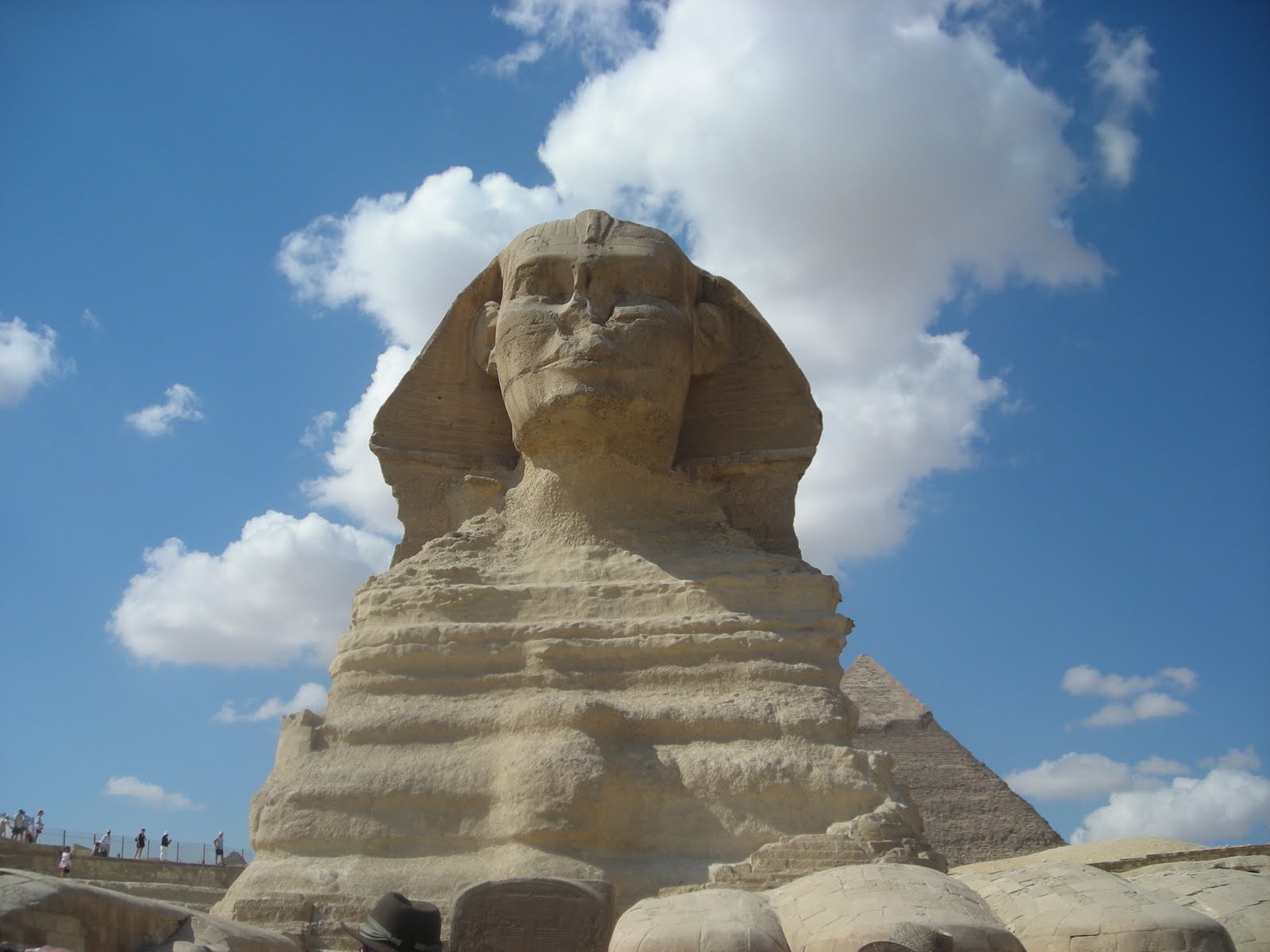
Above us, the throngs look over a railing down into the excavation, but we are standing at the very paws of the Great Beast.

We are here only because this is where we are to meet Dr. Hawass, at the Dream Stele at the base of the Sphinx. We wait for a few minutes and then suddenly, he appears in his uniform of blue jeans, blue shirt and infamous hat looking exactly like he does on every National Geographic special.

This has to be one of the most surreal moments of my life. Standing at the paws of the Sphinx with hundreds of tourists looking down at us, as we listen to the leading Egyptologist in Egypt today talk about his work, his explorations and his newest discoveries. Among the most intriguing, is the revelation that sometime in the next few weeks, as a result of DNA testing in new labs that specialize in DNA from mummies, he and his ream will reveal the parents of King Tut. Later I asked his assistant, April, if the world would be surprised at the names and she smiled nearly as enigmatically as the Sphinx itself before saying that it was Zawi’s to report, adding that the details had been checked and rechecked three times so that when the announcement comes, it will be definite. To think that within a month one of the great mysteries of the 18th Dynasty will be solved!

At the end of his talk about the preservation, and a Q and A session, Dr. Hawass allowed each of us to have our picture taken with him and while I never really want my picture taken with a celebrity, I made an exception of the man who will go down in history with the greats like Howard Carter and Flanders Petri. It seemed like a good thing.

As Dr. Hawass and his guards left, our group moved to the shady side of the Great Beast. Since no one is allowed to be this close, the fine sand was footprint free. I stepped into the powder and then took a picture of my sole print, feeling a bit like I was photographing a print on the surface of the moon.
We were free to look about, so I decided to circumnavigate the Sphinx. As I stopped to stare up at the gigantic face, I caught sight of a small dark scorpion, which I assiduously avoided, crawling over the casing as well as several very intent long-legged black ants. As I came around the far side, viewing the profile was a heart-stopping moment.


Against the blue sky, dotted with angelically photoshopped clouds was that profile. The most famous stone profile in the world. It took my breath away.
Coming back to the front, I was alone, so I rested my palms on the sacrificial altar directly between the paws and stared through time at the Dream Stele. The antiquity of the place suddenly overwhelmed me and the thought that I was standing where virtually no one gets to go hit me. I began to cry. This was my pilgrimage, my Mecca, my Rome. And it was every bit as astonishing as I had ever hoped.

Leaving the Sphinx, the modern world intruded in the reality of a one-way road. We couldn’t be driven back up the hill. We had to climb the causeway in an aerobic exercise and diagnostic knee strength testing. At the top, we started again on our aborted tour of the Solar Boat museum.

Long ago I read that the Queen Mother told Prince Charles that he should always sit instead of stand, ride instead of walk and never pass up a chance to go to the bathroom. I passed up the bathroom but when I saw a wooden chair standing lonely sentinel at the edge of the boat pit, I immediately snagged it. Right under the air conditioning, with a view down into the pit, I sat and blissfully allowed the possibility of heat stroke to be blown away.

Eventually the group reassembled. Bathroom breaks take awhile. And we climbed up three stories to see the reconstructed Solar Boat. It is astonishing to think that the Cedar of Lebanon still gave off a sweet aroma when the pit was first opened in the 1950s. The boat itself is much much larger than I expected, although why I expected it to be small, I don’t know. It is beautifully preserved from the originally matting that lay over the top of the cabin to the huge oars in the shape of spearheads to defend against an evil god who causes sand bars to move. The only thing that is modern is the rope used to lash it together. The original rope still exists, but for safety purposes, modern rope was used.


Leaving the Solar Boat, Fadel informs us that it is now time to enter the Pyramid of Khufu, to climb to the King’s Chamber if we are so inclined. In order to preserve the interior, only 300 tickets are issued each day and it is necessary to be in line at 6 am. Unless, of course, you are Fadel and a personal friend of the Deputy Minister of Antiquities. (Just as an aside, April said to me that no one in all of Egypt has better connections than Fadel. I believe her. He is amazing.)

I am a little scared of the climb. I’ve seen pictures of the low ceiling where you must crouch to climb and then the Grand Gallery with its very steep ramp staircase. I also know you climb about 2/3 of the height of the Pyramid and I know that I’m not in great shape and I already ache from the fibro, but fear be damned and fibro be banished. I decide I’m going to do this no matter what. It is my only chance and I’m not giving it up.

The climb is as arduous as I dreaded. It’s very steep, very narrow and very hot. Definitely not for the claustrophobic or the faint of heart for once you are committed to the climb, there is no turning back. It’s up and up and up in the heat, the dark and unknown. And then there is the descent. It is so steep one could probably slide down and if one lost one’s footing, you would probably take out at least 20 other climbers in your fall.

After a breath-robbing, heart pounding, knee aching climb we arrive at the King’s Chamber. It was everything I expected and nothing at all what I expected. It was totally black, as much from the color of the walls as from the complete and utter darkness pierced only by a few rather dim lights. But what gave the experience an eerie hue as that a woman, arms open to the ceiling, was chanting over the sarcophagus. The resonance vibrated deep into my chest and I could feel the notes echoing in the very cells of my being. After she quit singing, I moved in the sweltering oppressive heat to her place and laying my hands on the cool stone, I said a silent prayer for all who had stood here before me, inside the Great Pyramid of Khufu.

The climb down was as bad as I had anticipated. Hard on the knees, hard on the shoulders as I braced on the rails, hard on the back as I crouched in a near crawl though the winding corridors. Besides the fact I was extremely proud of myself for having actually accomplished this feat, I learned I’m not especially claustrophobic since the dark and closeness didn’t’ really bother me. Of course, the pounding of my heart, the gasping for breath, the aching in my calves and thighs might have mitigated any minor claustrophobia. When you think you might have a heart attack, a little darkness is immaterial.


I knew I was hot…sweltering actually…in the interior, but I didn’t realize just how hot until I got out and the afternoon breeze, which had been quite warm, was down-right chilly. How interesting it is that your perception can change so rapidly.
We geese returned to the bus behind our leader and we headed for a late lunch. After winding through narrow streets shared equally by pedestrians, cars, donkeys, goats, carts and the occasional cat, we parked and…walked some more, passing a stable with bony horses and bored camels for hire. Turning a corner, we came to the restaurant and as we waited for the door to be opened, we shared the street with various Arabian horse, a foal and one donkey who was hot-footing it as fast as he could clip-clop around the corner. Oh the delightful incongruity of a Mercedes bus, a Peugeot cab, a Japanese car, a grey donkey, a sandy camel, black and white goats, a dun mare and foal and a calico cat---all just outside the restaurant where we were having lunch. If the sights weren’t enough to convince me I was in Kansas anymore (although I’ve only been in Kansas once and really don’t want to return), the noises would be a sure sigh. The guttural grown of the camels, the braying of the donkeys, the yelling of the men all punctuated with the rap of hooves from a quick-stepping horse.

Following lunch which was a fabulous assortment of vegetables, of which we tender stomached Americans were told to eat only those that were cooked, we got up close and personal with the camels on the stoop by taking a camel ride through backs streets with tiny shops, children playing the games children play everywhere, camel dung, donkey piles, dirty puddles and a crush of horse-drawn carriage, camels, goats and people. Eventually we came to a gate with Tourism Police who let us go out into the desert for a photo op of riding a camel with the Pyramids in the background. It was a completely kitschy, completely romantic and absolutely wonderful moment.
One word of warning, when the drivers tell you to “lean back and hold on,” that’s just what they mean: “lean back as far as you can and hold on for dear life” because the camel rocks up and in case you haven’t been next to a camel recently, they are very very tall. If you don’t lean back and hold on, you will most definitely fall off. Even though I had been on a camel before, the one I rode was very tall and it was a very long way to the ground.


On the way back to the hotel, we had a shopping opportunity at a jewelry store which specializes in gold cartouches with your name. I wasn’t even going to go in, but I was talked into leaving the bus to just “look around.” I didn’t think I would find anything since I have more than enough jewelry I don’t wear, but lo and behold, in the back I found small statues of Egyptian gods. I added Hathor and Sekmet to my collection.

Several of our group were going to an Indian restaurant and others were following the one we call Maid Marion to a grill. But I was way too tired for another excursion and besides, I had promised myself that I would keep my journal and notes up, so I opted out. Good thing because I ate at the coffee shop at Mena House and fell asleep twice over my fried egg, turkey and veal sandwich.

Tomorrow we go to Saqquarah and Dahshur.